


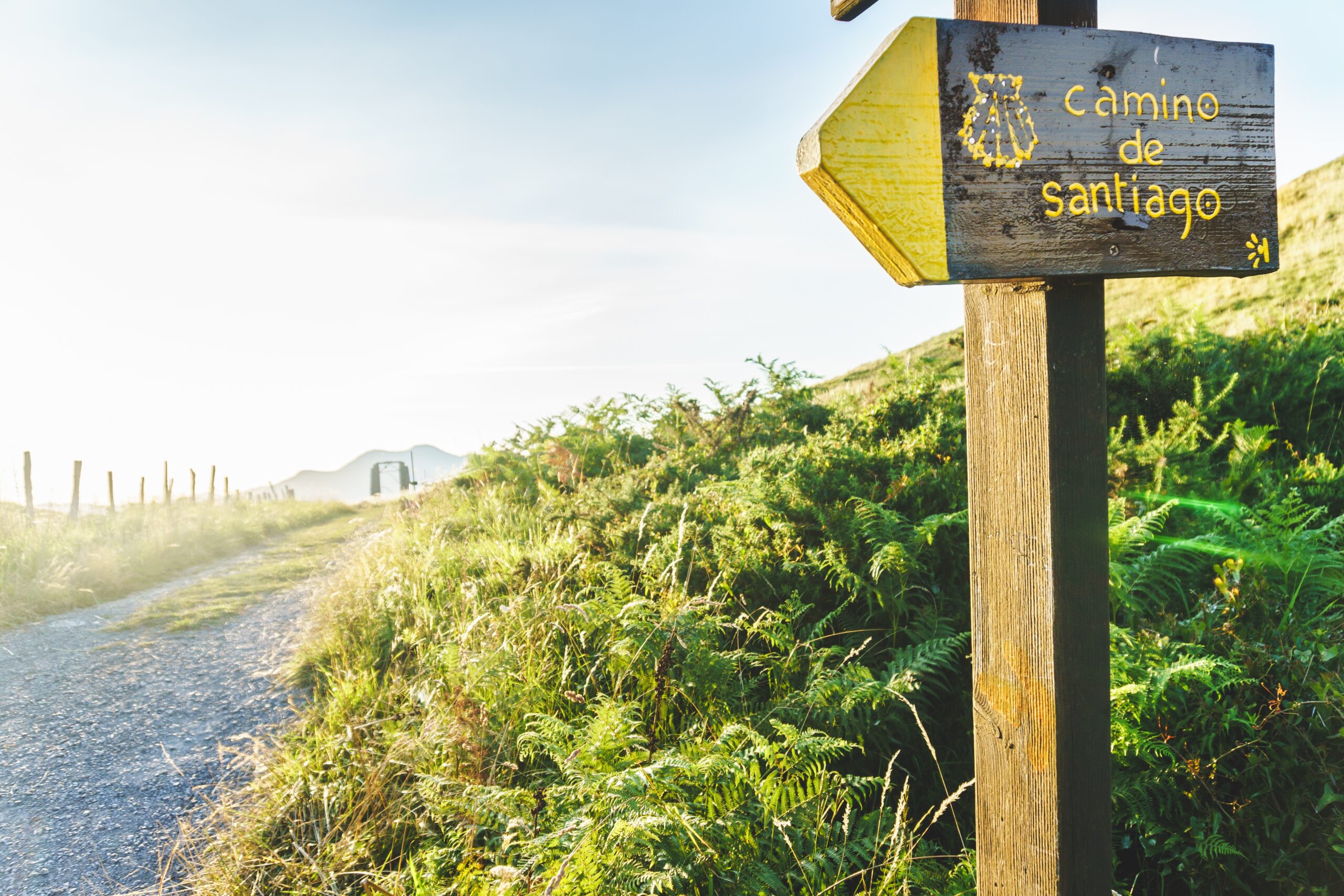
Have you ever imagined swapping a weekend of traffic and shopping centres for a few days cycling between crystal-clear rivers, traditional villages and landscapes where nature sets the pace?
More and more people are choosing to travel the Ways of St. James by bicycle. Besides allowing you to complete the route in fewer days, it is an excellent way to discover new landscapes, challenge your own limits and enjoy a different kind of experience without losing the essence of the pilgrimage.
Among the various routes available, the Caminho de Santiago Ribeiro Minhoto stands out for its tranquillity, natural landscapes and passage through some of the most beautiful areas of Northern Portugal. Along the route you will find rivers, traditional villages, rural paths and heritage that makes each stage different from the previous one.
But is it a good option for those who want to do the Camino by bike? How many days does it take? Is it a difficult route? Which bicycle should you choose? And where is it worth staying overnight?
In this guide, you will discover how many days it takes, the difficulty of the route, which bicycle to choose and where to stay while cycling the Caminho de Santiago Ribeiro Minhoto.
Can the Caminho de Santiago Ribeiro Minhoto be done by bicycle?
Yes. The Caminho de Santiago Ribeiro Minhoto can be completed by bicycle and is currently one of the routes chosen by many cycle tourists looking for an alternative to the busier Ways of St. James.
The route connects Braga to Santiago de Compostela, crossing Alto Minho and entering Galicia after passing through Melgaço and Cevide, covering approximately 266 kilometres. Although it retains its identity as a pilgrimage route, it is perfectly suitable for those who wish to ride it on a mountain bike, gravel bike or electric bike.
Before you start planning your trip, here is a quick overview of the route.
| Approximate distance | 266 km (from Braga) |
|---|---|
| Average duration | 4 to 7 days (up to 10 days for those who prefer shorter stages) |
| Difficulty level | Moderate (varies depending on the stages, elevation gain and type of surface) |
| Recommended bicycles | Mountain bike, Gravel and E-bike |
| Best time of year | Spring and autumn |
| Type of surface | Secondary roads, rural paths and some unpaved sections |
Unlike walking the route, cycling the Camino allows you to cover greater distances each day while still having the freedom to stop and enjoy the scenery, visit historic villages or discover some of the most beautiful corners of Alto Minho.
By bicycle or on foot: which is the best option?
There is no single right answer. It all depends on the experience you are looking for.
While walking the Camino de Santiago favours a more contemplative pace that is closely linked to the tradition of pilgrimage, cycling it allows you to discover a larger section of the route in less time while maintaining close contact with nature and the landscapes of Alto Minho.
If you only have a few days available, cycling may be the best solution. Those who wish to experience the pilgrimage in a slower and more introspective way may prefer to walk it.
| Camino by bicycle | Camino on foot |
|---|---|
| Around 4 to 7 days | Around 10 to 14 days |
| Ideal for cycle touring and short getaways | Ideal for traditional pilgrimage |
| Allows you to cover more kilometres per day | Shorter stages and a more relaxed pace |
| Requires some physical preparation and a suitable bicycle | Requires endurance to walk for several consecutive days |
| Recommended for mountain bikes, Gravel bikes or e-bikes | Only walking equipment required |
Whichever option you choose, the Caminho de Santiago Ribeiro Minhoto is distinguished by its natural landscapes, tranquillity and the authenticity of the towns and villages it passes through. If you are still undecided between walking or cycling the route, it is worth considering the time you have available, your physical fitness and the kind of experience you want to enjoy.
Not sure which option is right for you? Also read our complete guide to walking the Caminho de Santiago Ribeiro Minhoto and discover how to plan each stage.
How many days does it take to cycle the Caminho de Santiago Ribeiro Minhoto?
One of the most common questions among those planning this adventure is how much time is needed to complete the route.
The answer depends mainly on each cyclist’s pace, physical preparation, the type of bicycle used and the number of stops you want to make along the way. While some cyclists complete the route in four days, others prefer to divide the journey into six or seven stages to enjoy the scenery at a more relaxed pace.
As a general guide, you can consider the following:
| Kilometres per day | Approximate duration | Ideal for |
|---|---|---|
| 20 to 35 km | 8 to 13 days | Beginner cyclists or those who want to enjoy each stage at a leisurely pace |
| 35 to 50 km | 6 to 8 days | Most cycle tourists |
| More than 60 km | 4 to 5 days | Experienced cyclists |
These estimates are only indicative, as the starting point may vary. The main route can start in Braga, but some cycle tourists choose to begin closer to the border, such as in Ponte da Barca or Arcos de Valdevez. Therefore, the total distance and number of days required will always depend on where you choose to start.
Whatever duration you choose, one of the most beautiful stages of the route passes through Arcos de Valdevez, where Quinta Lamosa offers ideal accommodation to recharge your batteries before continuing the journey.
More important than covering a specific number of kilometres is adapting the route to your own pace. After all, one of the greatest attractions of the Caminho de Santiago Ribeiro Minhoto is precisely the opportunity to stop and discover historic villages, enjoy nature and sample the local cuisine.
What are the stages of the Caminho de Santiago Ribeiro Minhoto by bicycle?
There is no single way to divide the Caminho de Santiago Ribeiro Minhoto. The number and length of the stages will depend on your physical preparation, the type of bicycle you use, the time available and where you decide to start the route. As an example, a cycle tourist travelling at a moderate pace (35 to 50 km/day) could divide the route as follows:
| Stage | Route | Approximate distance |
|---|---|---|
| Stage 1 | Braga → Arcos de Valdevez, via Via Verde and Ponte da Barca | ±44 km |
| Stage 2 | Arcos de Valdevez → Monção, via Extremo | ±44 km |
| Stage 3 | Monção → Cortegada, via Melgaço and Cevide | ±60 km |
| Stage 4 | Cortegada → Soutelo dos Montes, via Ribadavia, Pazos de Arenteiro and Feás | ±62 km |
| Stage 5 | Soutelo dos Montes → Santiago, via Forcarei, O Foxo and A Gandara | ±56 km |
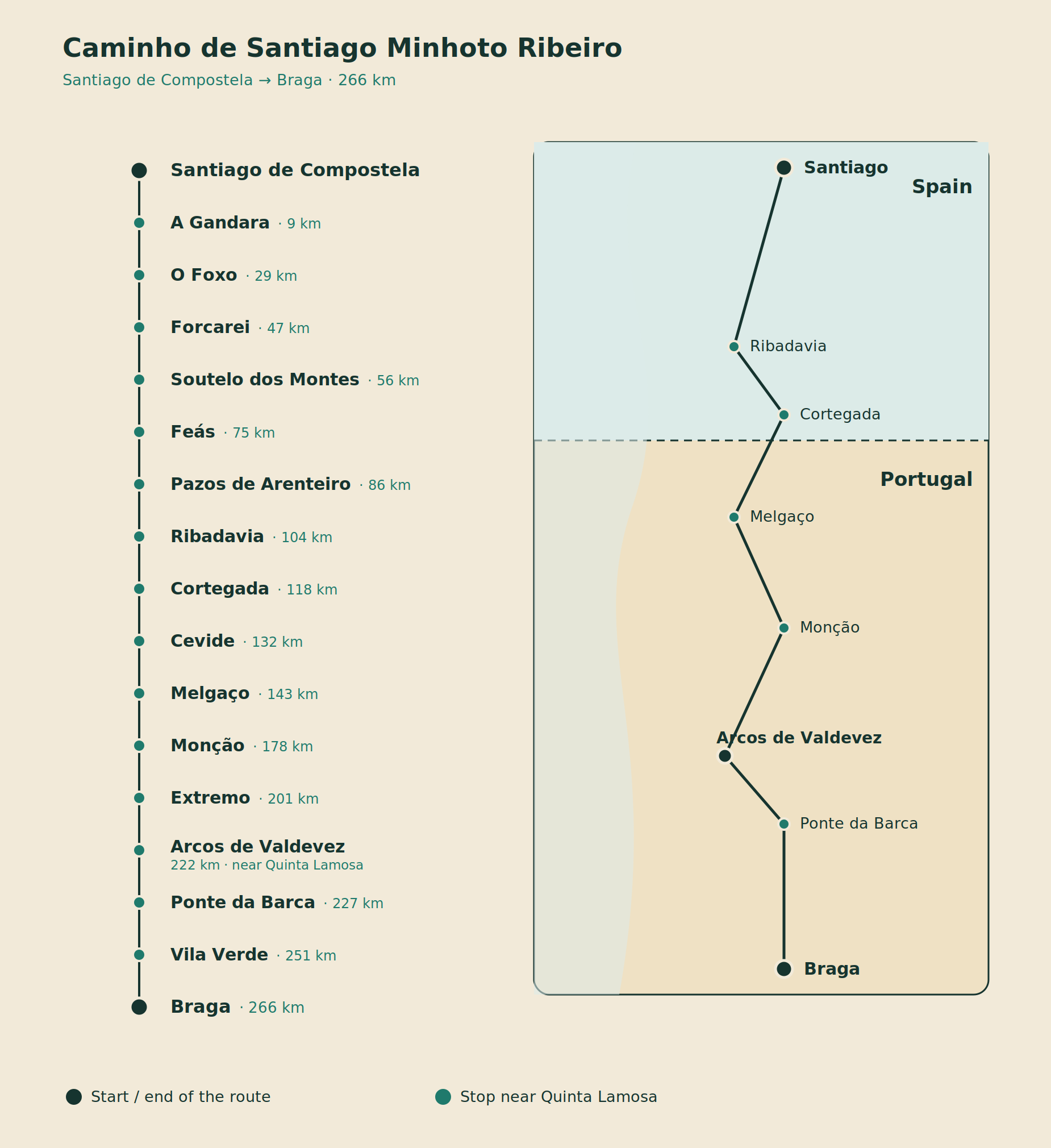
This breakdown is only an example. The number of stages and the distance of each should be adjusted to your pace, physical fitness and the places where you intend to stay overnight.
- When planning each stage, you should not consider only the number of kilometres. Elevation gain can make a short distance more demanding than a long and relatively flat stage. Therefore, check the elevation profile in advance and avoid concentrating too many climbs on the same day, especially if you are not used to cycling for several hours in a row.
- The type of surface also affects your pace. Secondary roads allow you to progress more quickly, while rural paths, dirt sections or uneven terrain may require greater attention and reduce your average speed. Weather conditions can also significantly change the difficulty of the terrain.
- Another essential aspect is the location of your accommodation. Ideally, define your stages according to the places where you can stay overnight, avoiding extra kilometres at the end of the day. Booking in advance also allows you to check whether the accommodation offers parking or a suitable place to store your bicycle.
- You should also identify the main resupply points along the route. Before each stage, check where you can buy water, food or have a meal, especially on sections that pass through more rural areas.
- If you use an electric bicycle, take the battery range into account. Elevation gain, luggage weight and the level of assistance selected can reduce the distance you can cover on a single charge. Therefore, check in advance where you can charge your e-bike and always carry the charger with you.
- It is equally important to leave some room for unexpected events. A mechanical problem, a demanding climb or a change in the weather may force you to finish a stage earlier than planned.
Is this route suitable for beginners?
✔️ Yes, provided you adapt the route to your fitness level.
The Caminho de Santiago Ribeiro Minhoto is accessible to most people who already have some cycling experience. However, it should not be mistaken for a completely flat or urban ride.
If you are not used to long routes, we recommend starting your preparation a few weeks before the trip. Short bicycle rides, gradually increasing the distance, will help your body adapt to the effort of cycling for several consecutive days.
For those looking to reduce the physical effort, an electric bicycle can be an excellent alternative, particularly on steeper sections.
Which bicycle should you choose?
The choice of bicycle depends mainly on the type of route you want to ride. For this Camino, the most suitable options are:
- Mountain bike, ideal for dirt roads and trails.
- Gravel bike, perfect for alternating between roads and rural paths.
- Electric bicycle (e-bike), recommended for those who want to reduce the effort on climbs or enjoy the journey at a more relaxed pace.
Before starting the route, always check the condition of your bicycle, including the brakes, tyre pressure, gears and lights.
What should you take with you?
Good preparation helps prevent problems and allows you to enjoy the route more fully. Do not forget to take:
- Helmet;
- Water and some snacks;
- Puncture repair kit;
- Bicycle pump;
- Mobile phone with GPS;
- Power bank;
- Lightweight waterproof jacket;
- Sunscreen.
If you use an electric bicycle, also check the battery range and the places where you can charge it during the journey.
Five tips to make the most of the route
Before you start, here are a few simple tips that can make all the difference:
- Plan each stage according to your fitness level.
- Check the weather forecast along the entire route, especially in higher-altitude areas.
- Take breaks whenever you find a place worth appreciating.
- Carry enough water, especially on hotter days.
- Do not rush. The best part of this route is not reaching the destination, but everything you discover along the way.
Where should you stay during the Caminho de Santiago Ribeiro Minhoto?
Choosing your accommodation is one of the most important decisions when planning the Caminho de Santiago Ribeiro Minhoto. After a full day of cycling, a good night’s rest allows you to recover your energy, prepare for the next stage and enjoy the experience much more comfortably.
There are several accommodation options along the route, but the best choice will always depend on how you divide the stages and the pace at which you intend to complete the Camino de Santiago. Ideally, choose places close to the route, with restaurants and other essential services nearby, and a peaceful environment where you can rest.
Arcos de Valdevez combines nature, heritage and a good range of services, making it a strategic stop during the early stages of the Camino, both for those completing the route all the way to Santiago and for those covering only some sections.
If you are looking for accommodation in this area, Quinta Lamosa, located in Gondoriz just a few minutes from the centre of Arcos de Valdevez, offers particularly suitable conditions for resting between stages. The holiday homes are completely independent and include an equipped kitchen, parking, free Wi-Fi, spacious outdoor areas and a saltwater swimming pool, providing all the comfort you need to recover after a day of cycling.
More than simply a place to sleep, Quinta Lamosa allows you to enjoy the characteristic tranquillity of Alto Minho, wake up surrounded by nature and return to the Camino with renewed energy for the next stage.
We answer the most frequently asked questions!
Is it possible to complete only part of the Caminho de Santiago Ribeiro Minhoto?
Yes. You do not need to complete the entire route to Santiago de Compostela. You can choose only a few stages according to the time you have available, your physical preparation and the type of experience you are looking for.
What is the best time of year to complete this route?
Spring and early autumn are the most recommended times of year, thanks to mild temperatures and particularly beautiful landscapes. In summer, the route is still an excellent option, provided you favour the early morning hours to avoid the heat.
Where can I charge an electric bicycle?
Some accommodation providers allow electric bicycles to be charged. Quinta Lamosa has charging points for electric vehicles; check in advance whether they can be used to charge your e-bike.
Is there parking for bicycles and cars?
Yes. Quinta Lamosa offers free parking, making the stay easier for guests travelling by car and carrying bicycles to explore the region.
Can I do the route alone?
Yes. Many cycle tourists complete this route alone. However, it is advisable to plan each stage carefully, download the route to your GPS, inform someone of your itinerary and make sure you carry the essential equipment for unexpected situations.
Is the route signposted?
Yes. Much of the route is marked with the usual Way of St. James signage. Even so, using a GPS app is recommended, as there may be junctions or alternative sections where the signs are not completely clear.
Can I receive the Compostela if I complete the route by bicycle?
Yes. You must cover at least the final 200 km to Santiago and present a properly stamped Pilgrim’s Credential.
Do I need to book accommodation?
It is recommended, especially during spring and summer, when the number of pilgrims and cycle tourists increases. Booking in advance allows you to plan each stage more effectively and avoids having to extend your day’s route because there is no accommodation available.
Discover the Camino at your own pace
The Caminho de Santiago Ribeiro Minhoto is much more than a pilgrimage route. It is an invitation to discover authentic landscapes, cross villages full of history and explore one of the most beautiful regions of Northern Portugal and Galicia on two wheels.
And perhaps that is precisely the best thing about this route: there is no single way to experience it. In the end, more than the kilometres travelled, what remains are the landscapes, the moments you experienced and the desire to return.
So… are you ready to ride?
Book your stay at Quinta Lamosa now and start planning your next adventure!